01 Eye Tightness · Discomfort
Zhuque Soothing Eye Gel
Apply around the eyes for a light, fresh, hydrating feel. No need to put the gel in your eyes.


Pioneering consumer applications of new biomedical materials
Traditional approaches often focus on selecting and delivering active ingredients. Tetrahedral framework nucleic acid (tFNA) technology lets us consider the entire journey: maintaining stability, crossing tissue barriers, entering cells, releasing actives on demand, and interacting with the tissue microenvironment.
Explore more
tFNA · KEY FEATURE
Tetrahedral framework nucleic acids (tFNA) are three-dimensional biomolecular scaffolds self-assembled from designed DNA sequences. They have intrinsic biological activity and can deliver other active ingredients. Their size, ingredient positioning, and response to biological signals can be precisely designed, creating a foundational biomaterial platform for organizing and regulating multiple active components.
STRUCTURAL PRECISION
The three-dimensional tFNA framework offers mechanical stability and resistance to degradation, protecting active molecules and helping them retain the shape they need to function.1
INTRINSIC BIOACTIVITY
Research shows that tFNA is more than a delivery vehicle: it has intrinsic antioxidant and inflammation-modulating activity and helps regulate cell proliferation, migration, differentiation, and homeostasis, supporting cellular repair and regeneration.1
PROGRAMMABLE LOADING
tFNA allows precise control over the position, number, spacing, and arrangement of active ingredients. Ingredients can be organized to coordinate how and where they act, rather than simply being loaded onto a carrier.1
REGENERATIVE SUPPORT
Research on wounds, fibrosis, and tissue regeneration shows that tFNA can act at multiple stages, helping damaged or imbalanced tissue environments become more conducive to repair.1
PRODUCT
01 Eye Tightness · Discomfort
Apply around the eyes for a light, fresh, hydrating feel. No need to put the gel in your eyes.
02 Dry Scalp · Fine, Brittle Hair · Oiliness & Flaking
Morning and evening leave-in care to hydrate, repair, and nourish.
03 Neck & Shoulder Tension · Lower Back & Leg Heaviness · Knee & Ankle Aches
Portable 5 mL spray. Targeted application. Light and quick-drying.
04 Dullness · Sensitivity & Redness · Uneven Tone
A two-bottle routine for daytime brightening and nighttime repair, supporting an even skin tone and helping maintain skin barrier function.
— More applications are taking shape —
tFNA × HERBAL BIOACTIVES
Small molecules from herbs act across multiple pathways, biological levels, and targets. Modern pharmacology can study and evaluate their effects while exploring ways to deliver them. Yet poor water solubility, low stability and bioavailability, rapid metabolism, and biological barriers make effective concentrations difficult to achieve. tFNA offers a new way to address these limitations.
Efficient loading through four methods: intercalation, groove binding, electrostatic adsorption, and covalent conjugation.
Complexes of tFNA and bioactive small molecules show improved stability and water solubility, along with more sustained release.
Helps bioactive small molecules cross biological barriers, including skin, the vitreous, articular cartilage, and cell membranes.
Adding aptamers or targeting peptides can increase accumulation in specific cells and even organelles.
tFNA’s intrinsic biological activity can work synergistically with small molecules from herbs.


Driven by Science
In 1982, Nadrian Seeman proposed design principles for DNA self-assembly. In 2013, Professor Yunfeng Lin’s team began exploring the biomedical applications of tFNA. After more than a decade of research and refinement, tFNA has reached its fourth generation, evolving into a safe and efficient nucleic acid nanoplatform with intrinsic biological activity and the ability to deliver a wide range of active substances.

Deputy Party Secretary, West China School of Stomatology, Sichuan University · Deputy Director, State Key Laboratory of Oral Diseases
Chief Scientist, Chengdu Yunhai Tetrahedron Biotechnology Co., Ltd.
Building on the work of the research team led by Professor Yunfeng Lin, Chengdu Yunhai Tetrahedron Biotechnology Co., Ltd. (Yunhai Bio) has developed a versatile tFNA technology platform with proprietary intellectual property, integrating basic research, technology translation, and industrial applications. Its wholly owned subsidiary, Chengdu Qinghe Tetrahedron Biotechnology Co., Ltd., focuses on innovative consumer applications of tFNA.
REAL USER EVIDENCE
Real accounts of product use and changes observed in scalp, eye, and skin care.


"Nourishing and repairing the scalp helps strengthen hair at the roots and improve the appearance of the part."
Ms. Kong · Edited follow-up notes
 DAY 01
It felt cool when I first applied it. After about 2 minutes, the area around my eyes felt slightly warm.
DAY 02The first thing I noticed when I woke up was how moist my eyes felt. I didn't notice any tightness.
DAY 04I only felt the warmth the first time. It did not happen again, and I did not notice anything else in particular.
DAY 07My eyes feel more and more comfortable. The gritty, stinging sensation has not returned, and they feel comfortably moist.
DAY 10My eyes do not feel as uncomfortable after staying up late.
TESTING & EVIDENCE
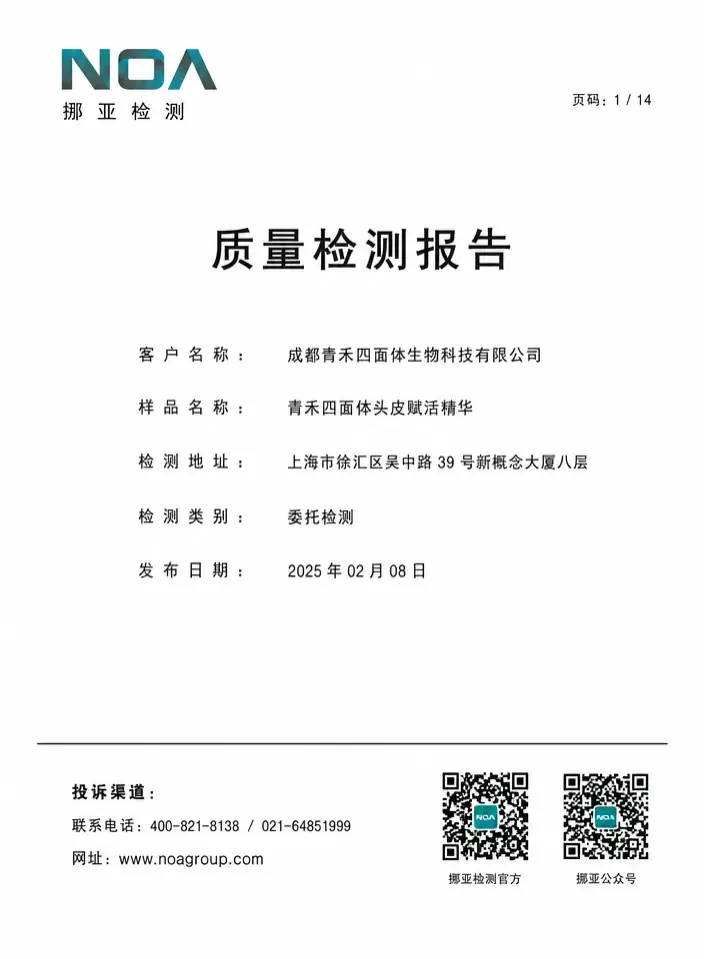
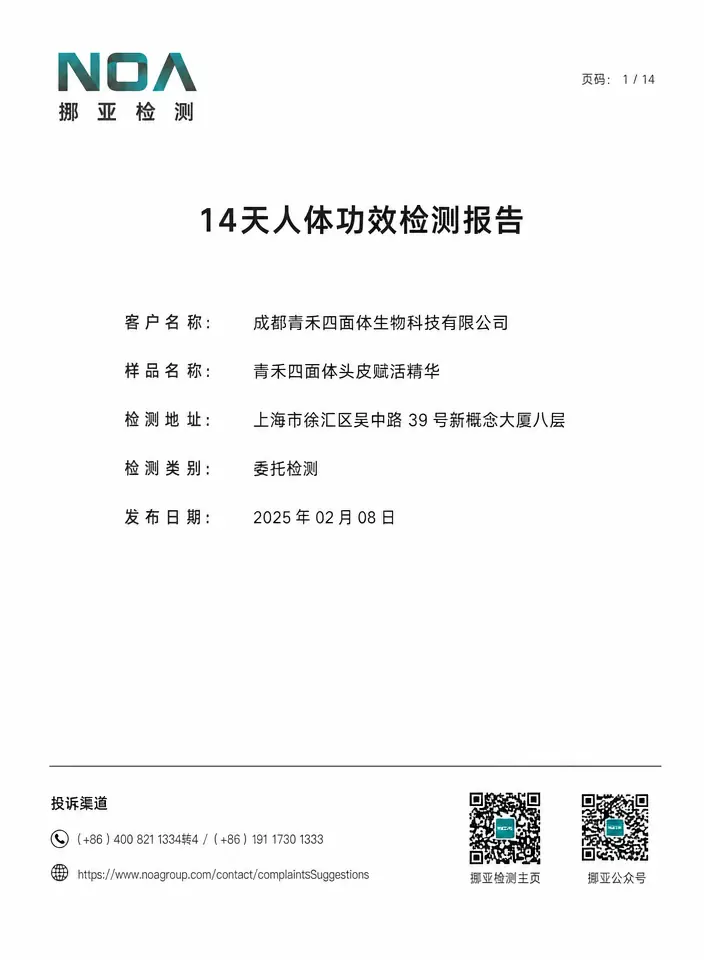
Qinghe Tetrahedron products have undergone testing and assessment by third-party laboratories across areas including safety, irritation, and efficacy.
View test reports →